
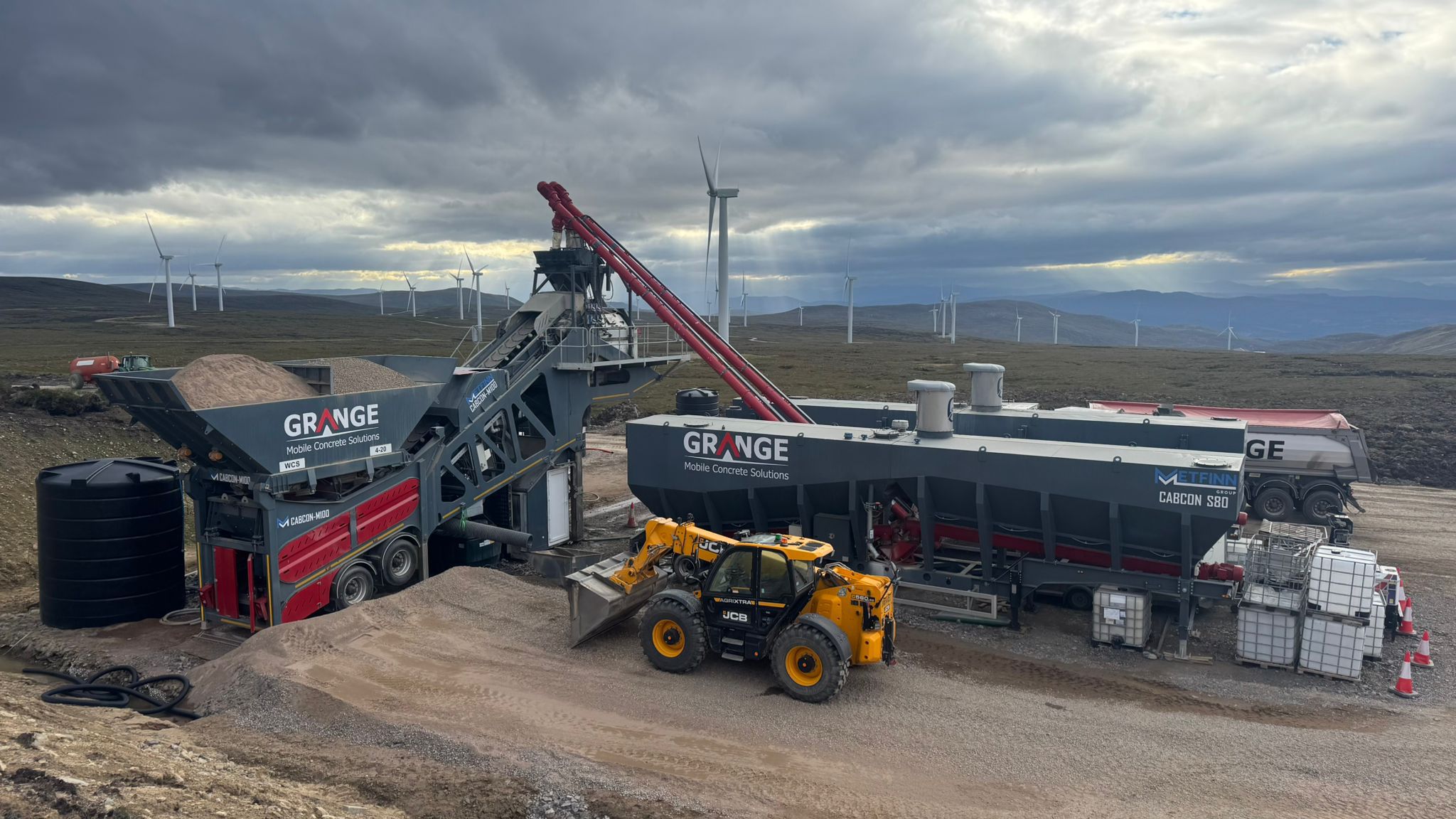
For this project, Grange was invited to supply concrete to the Aberarder Wind Farm. Although the project involved relatively modest pour sizes, Grange used the opportunity to continue the development of its No. 3 mobile concrete plant, which was originally designed for large, remote pours approaching 1,000 cubic metres per pour. These volumes present significant challenges, particularly in terms of supply rates and on-site material storage.
Grange initially collaborated with Carbragh to propose a novel cement screw arrangement for a standard mobile concrete plant belly silo. This collaboration led to the development and acquisition of a new plant designed to meet two key objectives: firstly, to accommodate the ever-increasing concrete volumes required for wind turbine foundations; and secondly, to significantly improve storage capacity and supply rates while operating within the limited footprint typically allocated to suppliers within site compounds.
Grange acted as design consultants on the project and subsequently tested and refined the prototype plant under live supply conditions on the Douglas Wind Farm projects (see separate case study), ensuring its performance met real-world operational demands.
Further fine-tuning of this development continued throughout the Aberarder project, specifically to maximise the cement storage capacity of the plant’s extended-length belly silos. Continuous improvements to delivery efficiency were implemented during this project, ensuring the plant is even better equipped to service future contracts.
By enhancing the delivery process in this way, Grange has successfully maximised volumetric output while maintaining a compact plant footprint. This integrated approach has resulted in more efficient and sustainable concrete supply practices, ensuring Grange continues to meet the growing demands of large-scale infrastructure and wind farm projects.


